
The Problem with Memory-Based Retail Research
Retail doesn’t happen in theory. It happens under fluorescent lights, between shelves, in front of price tags that may not be where they were yesterday. And yet, many surveys ask shoppers to remember what they saw days later.
Memory is stubborn. It fills gaps confidently. A mid-shelf becomes “eye level.” A modest promo becomes “a big campaign.” The brain edits quietly, and the dataset absorbs the edits.
For brands tracking shelf execution, price visibility, or competitive adjacency, that blur is not harmless. It shapes decisions.
This case explores how we designed a location-based market research approach that captures responses while the participant is physically inside the store: with location verification, guided store detection, real-time completion, and visual confirmation embedded in the survey logic.
Not layered on top. Built in.
Because in retail, context is not background, but evidence.
The Context — Why In-Store Truth Is So Hard to Capture?
The Limits of Traditional Retail Surveys
Standard in-store shopper research methods face predictable constraints:
- Recall bias distorts environmental detail.
- Remote participation cannot be confirmed.
- Fraud detection happens after fieldwork, often imperfectly.
- Physical audits require substantial operational coordination.
If a questionnaire can be completed from a living room, part of it will be.
That doesn’t make respondents dishonest. It makes the system permissive.
Retail teams, however, depend on clarity about what is happening on shelves, not approximations. Yet many studies separate digital surveys from physical validation, creating a structural gap.
The shelf becomes abstract and abstraction is risky when performance depends on physical presence.
The Client’s Core Challenge
The client needed respondents to:
- Visit nearby stores.
- Observe product placement and promotions.
- Evaluate competitive visibility.
- Complete questions on-site.
- Upload images of the environment.
The requirement was simple in wording and complex in execution: confirm that respondents were truly present without creating unnecessary drop-off.
It required more than instructions. It required architecture.
The Strategic Question — Can Location Be Verified Without Creating Friction?
Verification often increases complexity.
Add too many controls and respondents disengage. Add too few and the data weakens.
The challenge was to design geolocation survey technology that feels integrated rather than restrictive.
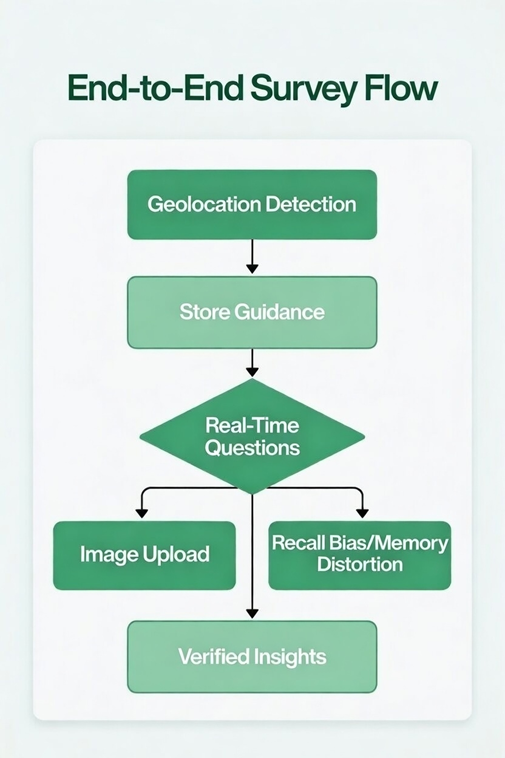
Instead of layering controls onto a traditional questionnaire, we restructured the survey around location detection and guided store access.
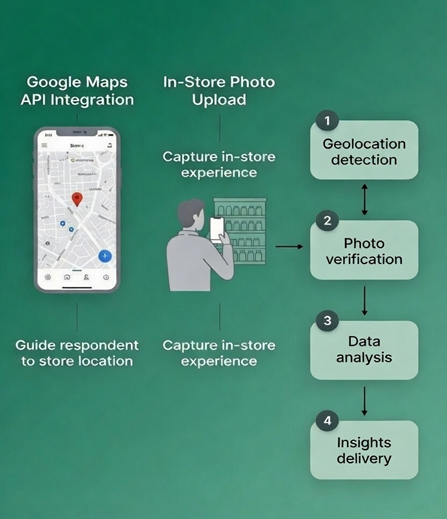
The system combined:
- Google Maps API integration
- Radius-based access control
- Real-time completion logic
- Image upload validation
The objective was structural reliability. A real-time retail survey should reflect real retail behavior.
The Solution — A Location-Integrated Survey Designed for Physical Reality
Google Maps API Integration
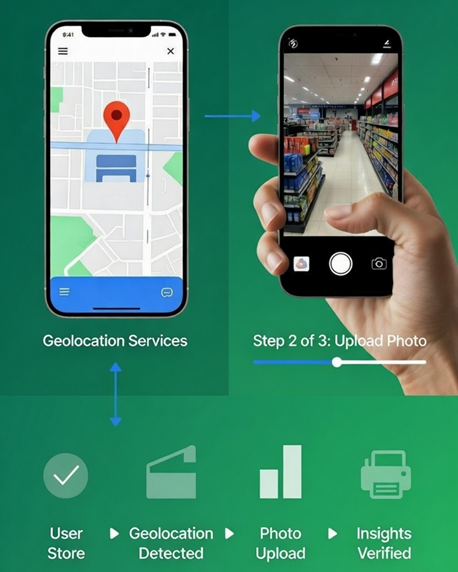
The survey integrated Google Maps API to detect respondent location and identify the nearest approved store.
Rather than asking participants to manually enter store names (a source of frequent inconsistency), the interface guided them automatically.
This alignment ensured:
- Accurate store identification
- Reduced self-reporting ambiguity
- Clear linkage between response and environment
Location was confirmed by the system, not declared by the respondent.
Access Gating Through Geolocation
Participants could only proceed once within a defined radius of the store. If they attempted to access the survey remotely, it remained locked.
This directly addressed two recurring issues in retail studies:
- Remote completion
- Unverified store visits
Quality was reinforced at entry rather than corrected later.
In many research projects, data cleaning becomes an invisible cost. Here, structural validation reduced that burden upstream.
Real-Time Question Completion
The survey logic required respondents to answer questions while physically present.
Not after leaving. Not later that evening.
In in-store shopper research, immediacy protects detail. Shelf positioning, price tags, competitor adjacency – these elements are contextual. Once the shopper exits, perception shifts.
Real-time completion preserved that context.
The study did not simply collect answers quickly. It collected them where they happened.
Image Upload for Visual Validation
Participants uploaded photographs of shelves and surrounding displays. This added a qualitative confirmation layer to the quantitative responses.
Images enabled:
- Visual validation of product presence
- Confirmation of promotional execution
- Cross-checking against reported observations
- Richer internal reporting
Charts describe distribution. Images document reality.
When internal teams review findings, visual evidence often reduces debate faster than tables alone.
Implementation — Automation With Research Discipline
A few key choices drove how the work actually got done:
- Selecting Google Maps API for reliability and scalability.
- Defining radius parameters suited to different store layouts.
- Designing mobile-first interfaces for in-store usability.
- Structuring logic pathways to prevent bypassing validation steps.
AI-assisted validation supported consistency monitoring and logic enforcement. However, human expertise guided:
- Which questions required visual confirmation.
- How to balance verification with user experience.
- Ongoing monitoring of field responses.
- Adjustment of logic where necessary.
This is where retail field research automation becomes operational.
Automation manages repeatable control. Human oversight shapes design and interpretation.
The Results — When Data Reflects Physical Reality
The transformation was qualitative and structural.
The study delivered:
- Verified store-level participation.
- Reduced reliance on recall.
- Image-supported responses.
- Clear linkage between respondent and retail environment.
- Greater confidence in shelf-level findings.
A client reflection captured the shift: “The combination of location verification and image uploads gave us a clearer view of what was actually happening in-store.”
Internally, something subtle changed. Discussions focused less on whether visits occurred and more on what the observations meant. Data moved from tentative to grounded.
In retail contexts, that shift affects decision velocity and alignment.
The study redefined how the client approached location-based market research. Digital data collection and physical validation no longer operated separately. They were integrated within one controlled structure.
A Practical Concern — Does Location-Based Research Increase Complexity?
Yes. It introduces technical components:
- API integration
- Geolocation permissions
- Mobile optimization
- Image storage and validation
Initial setup requires precision.
However, consider the alternative.
- Without structural validation:
- Fraud risk increases.
- Data cleaning demands rise.
- Confidence declines.
- Re-fielding becomes more likely.
With integrated geolocation survey technology, integrity is reinforced during collection.
Infrastructure requires investment. Unreliable insight requires correction.
For high-impact retail decisions, the balance often favors structural control.
Applications for Retail and FMCG Brands
This model is particularly effective when physical context drives performance:
- Promotion compliance tracking
- Shelf visibility audits
- Competitive adjacency monitoring
- Price validation studies
- New product launch observation
Not every study requires geolocation controls. Brand tracking and concept testing can operate without physical verification.
However, when shelf conditions shape outcomes, a real-time retail survey strengthens reliability. Scalable location validation allows broader deployment of retail field research automation without traditional audit teams in every region.
Once the foundation is in place, doing it again gets a lot easier.
A Few Things Worth Keeping
- Catch it at the point of entry, not later when it’s too late.
- Real-time completion protects environmental accuracy.
- Image validation strengthens reporting credibility.
- Location controls can scale across regions.
- Location-based market research reduces uncertainty in retail execution decisions.
- Strategic Reflections — The Direction of Retail Research
- Retail research is moving toward built-in verification.
Digital environments are faster. Response environments are noisier. Confidence depends on structure.
Three movements are visible:
- Verification integrated into data collection.
- API integration as part of research design.
- Automation works best when a human is still in the room.
Geolocation survey technology connects physical environments with digital data capture. It narrows the gap between what happens on shelves and what appears in reports.
Our role in this case extended beyond programming a questionnaire. It involved engineering a controlled research environment aligned with retail realities.
The distinction is subtle. It determines data integrity.
Conclusion — From Memory to Verified Presence
Retail unfolds in physical space: visible, measurable, and dynamic. When research depends on memory, those dynamics soften. When research verifies presence and captures responses in place, clarity strengthens.
This case demonstrated how location-based market research can integrate geolocation controls, real-time completion, and visual validation into a unified approach.
For brands whose decisions depend on shelf accuracy rather than recollection, structured verification changes the quality of insight.
If your next study depends on in-store precision, CodexMR can design a location-validated model aligned with your operational needs.
Let’s discuss how verified retail research could support your next project.