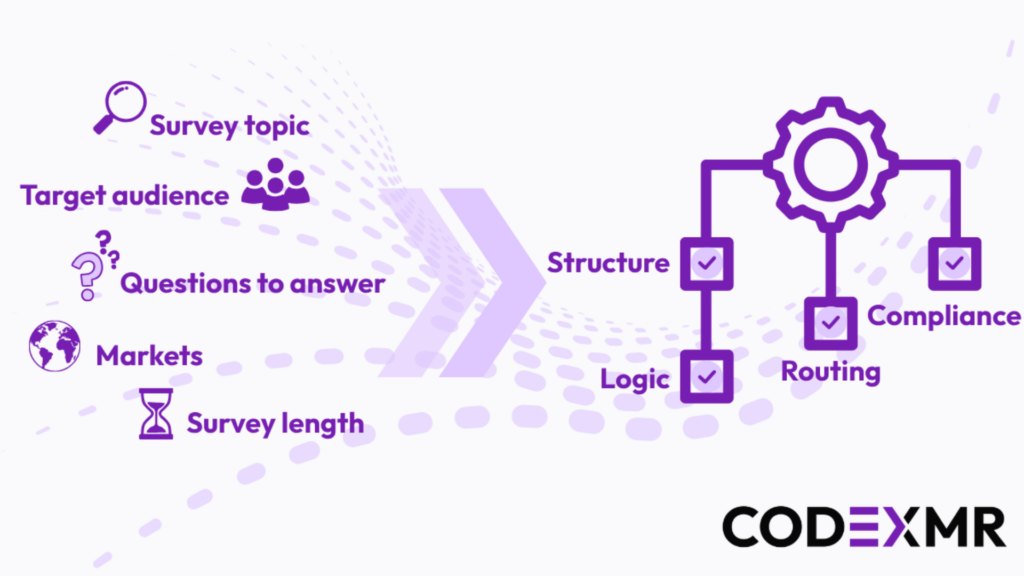
CodexMR’s survey design automation takes your research objectives and generates a complete, structured questionnaire framework automatically. Section order, question types, routing logic, screening criteria, GDPR compliance, country-specific requirements, demographic targeting, and methodology guidance: all of it comes out of a single input. By the time your team reviews the output, the foundational decisions are already made.
That matters because the earliest stage of a quantitative project, translating a client brief into a structure, is where most teams lose their first days. It runs on individual habit, institutional memory, and whoever is most senior in the room that day. Every team does it differently. Few teams do it fast. Codex MR Survey Design Engine changes both of those things.
What the CodexMR Survey Design Engine Does
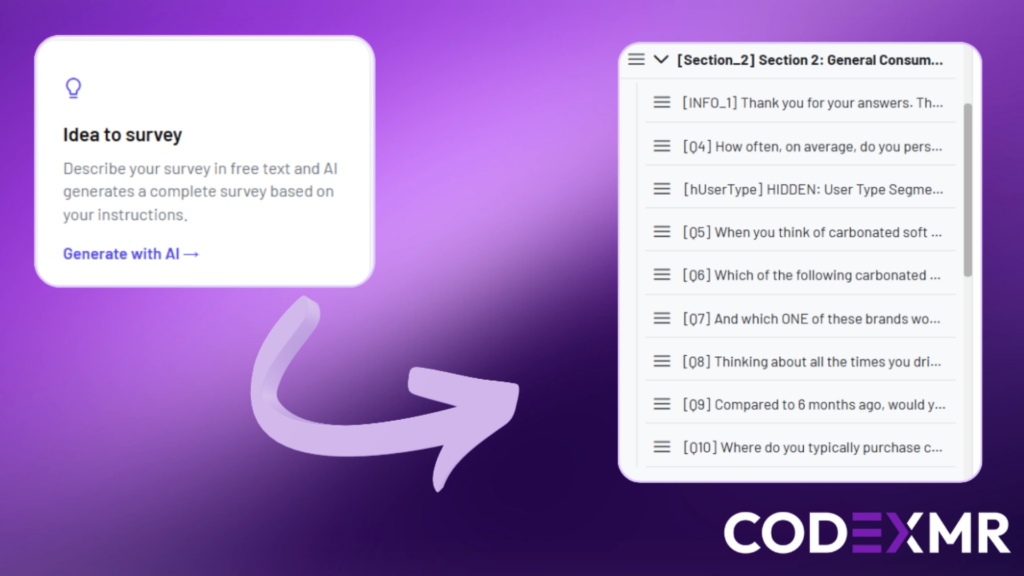
The engine sits at the very start of the CodexMR six-step workflow. You input your research objectives. The platform reads them, identifies the appropriate survey architecture, and returns a structured framework ready for review. Not a starting point. A working draft your team can review and refine directly before anything moves to fieldwork.
This is not a template picker. It does not ask you to choose a structure and fill in the gaps. The Survey Design Engine interprets what the research is trying to answer and builds the framework around that logic.
For researchers who have spent years watching questionnaire setup meetings run long, that shift is significant. The discussion moves from “how should we structure this?” to “does this structure reflect what we need?” That is a faster, sharper conversation.
Compliance and Country Requirements, Built in From the Start
One of the more consequential things the Survey Design Engine handles automatically is compliance, before the project reaches programming, QA, or fieldwork.
For multi-country studies, this gap has real cost. GDPR and privacy regulations requirements vary in application across markets. Country-specific question formats, language, age of consent definitions, and data collection rules can all affect how a questionnaire is structured. Sometimes during QA. Occasionally after fieldwork has started. At that point, the fix is expensive, and the timeline is broken.
The Survey Design Engine embeds these requirements by design. Select the target countries, and the framework reflects what each market requires. Demographic targeting specifications, the parameters that usually go back and forth between research and programming, come out pre-calibrated for the markets in scope. That includes complex audience splits like heavy vs. light users, which typically require custom screening logic.
The result is a framework that is structurally sound and already aligned with the compliance environment the project is operating in. That removes a category of late-stage rework before anyone has opened a scripting tool.
Methodology Support: MaxDiff, Gabor-Granger, and Other Advanced Designs
The Survey Design Engine does not flatten complex methodology into generic survey structures.
For projects that include prioritization work, MaxDiff design guidance is embedded directly in the framework output. The number of items, set sizes, and rotation logic come out specified rather than left to interpretation. For pricing research, Gabor-Granger methodology is supported, with question sequencing and price point architecture already reflected in the framework structure.
This matters because methodology errors at the framework stage are the hardest to catch and the most expensive to correct. A programmer working from an under-specified brief will make assumptions. Some will be wrong. By the time those errors surface, the questionnaire may be half-built and the timeline already under pressure.
When the framework comes from the Survey Design Engine, the methodology is specified from the start. The programmer receives a structure that reflects the research design intent, not their interpretation of an incomplete brief. This is where an automated survey framework becomes critical for keeping complex projects on track.
What Your Research Team Gains
The downstream effects of a well-generated framework reach every stage that follows.
- Faster project setup. The time compresses significantly. Teams currently spending two to three days negotiating questionnaire structure can move to review and refinement within hours. The Survey Design Engine does not replace that review. It gives the team something specific to react to rather than a blank page to fill.
- Cleaner handoffs to programming. Section flow, question types, routing logic, and methodology specifications are all present at handoff. That level of survey programming preparation reduces revision cycles and keeps the programming timeline predictable.
- Built-in methodology guidance. For teams that run specific methodologies such as MaxDiff or Gabor-Granger occasionally rather than daily, having the correct framework architecture generated automatically reduces the risk of design errors. The guidance is in the output, not in a separate reference document that someone has to remember to chec
Where the Survey Design Engine Sits in the Platform
The Survey Design Engine is the entry point to the CodexMR workflow. What it generates is not a standalone document.
A structure produced by the Survey Design Engine is made to move through automated translation, scripting, and QA without friction. Compliance groundwork is already laid. Methodology is already specified. Demographic targets are already defined. Each downstream step receives an input that was built to be processed, not interpreted by the next person in the chain.
For researchers managing high-volume workloads or multi-country trackers, this matters at scale. When multiple projects are moving through the platform simultaneously, the quality of what enters the workflow at step one determines how reliably everything that follows runs. A well-specified framework does not generate exceptions. It moves.
There is also a consistency benefit that is easy to underestimate. When the survey structure is built manually, every project starts from a slightly different baseline. Senior team members impose their own structural preferences. Junior team members fill gaps based on what they have seen before. Over time, that inconsistency compounds into unpredictable handoffs and variable project timelines. The Survey Design Engine gives every project the same structured starting point, regardless of who is leading it.
At scale, survey design automation ensures that every project enters the workflow with the same level of structure, clarity, and methodological intent- before a single line of code is written.
To see how the Survey Design Engine fits into your workflow, get in touch with our team.