A survey questionnaire passes through more than one pair of eyes before it goes to field. The researcher checks whether it supports the study objective. The programmer reads for routing and conditions. The QA looks for validation gaps. The compliance reviewer scans for data privacy issues. The language and localization expert checks market fit. The field manager reads for respondent burden. Somewhere in the process, someone needs to be confident the data will actually be clean enough to analyze. And the respondent — the one person none of these reviewers can speak for — needs a survey experience that is clear, fair, and worth completing.
In practice, that full survey quality control pass rarely happens. Not because teams skip it on purpose, but because most organizations don’t have all seven roles formally in place, the specialists who could fill the gaps are expensive and hard to schedule, and when nobody clearly owns the full picture, it quietly falls through.
ResearchReady is built around one premise: all seven of those specialist reviews should happen at least once, and that goes ideally before the questionnaire moves to programming, and they should not take days (or weeks) to organize.
What ResearchReady Does
ResearchReady is an AI-powered survey quality control tool for quant research teams. The user uploads a Word questionnaire and review areas relevant to the study, and receive a structured review across seven professional lenses:
- survey statistic
- research design
- survey logic consistency
- data compliance
- data quality,
- language and localization
- respondent experience
The output is brilliantly organized findings dashboard. Each issue is mapped to the exact section of the questionnaire where it appears, assigned a severity level, paired with a recommended next action, and made available in exportable formats for every team that needs to act on it.
This is not the usual AI generative system. ResearchReady does not write interpretations or produce summaries based on inference. It applies precise, rules-based checks against most up-to-date research methodology guidelines, programming specifications, and market standards, then organizes the findings into a format each specialist role can immediately use. The value is in the precision, coverage and the structure, not in a system making judgment calls about research intent.
Seven Specialist Lenses on the Same Upload
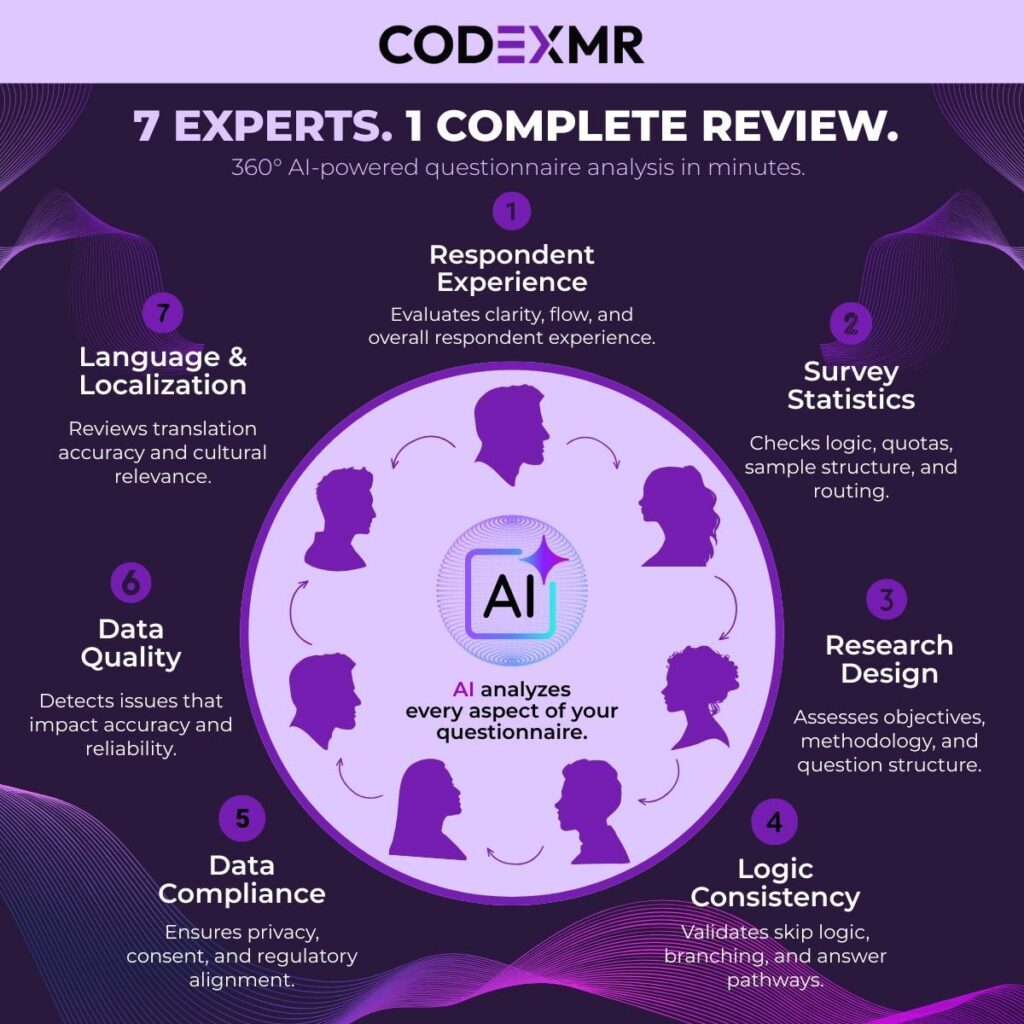
The seven review areas in ResearchReady correspond to the seven specialist roles that a complex quant survey requires. In most research operations, those roles exist across separate people, separate departments, and separate points in the project timeline. In ResearchReady, they run in parallel on the same document.
- The Survey Statistics panel gives the project manager the full picture to estimate the project timelines, costs and flags for potential issues: questions count complexity, estimated length of interview, grid density, open-end volume, and operations. The numbers that show whether the survey is realistic to build and realistic to complete, before it is handed to anyone to build.
- The Research Design review checks whether the questionnaire actually supports the business question. It reads for whether the questions support the study objective, screening quality, sample fit, and wording risks that could compromise the data before a single response is collected. This is the research lead’s lens: does the instrument do what the brief asked it to do?
- The Survey Logic review does the critical reading a programmer rarely has the time or incentive to do. ResearchReady traces every routing path, branching condition, and implementation blocker, including the conflicts that execute correctly but send the wrong respondents down the wrong path.
- The Data Compliance review scans for personal, sensitive, and consent-dependent data collection points tailored to each market. It surfaces PII signals, consent gaps, and sensitive-topic flags for the legal or privacy reviewer who needs to sign off before the study fields. This is not a legal clearance, and ResearchReady does not position it as one. It is a structured prompt that tells the qualified reviewer exactly where to look, with the source questionnaire alongside it.
- The Data Quality review looks forward into fieldwork. Validation gaps, weak quality checks, naming inconsistencies, trap question concerns. The checks that prevent the most common preventable problems in data collection and analysis.
- The Language and Localization review checks whether the questionnaire is ready for the markets it is targeting. Spelling convention, formality level, translation readiness, cultural fit, market-specific wording concerns. For multi-country studies, this review can surface issues that would otherwise appear after translation is already done and the timeline is already tight.
- The Respondent Experience review reads the survey from the inside. Fatigue signals, cognitive load, mobile friction, repetitive tasks, grid burden. The detail that directly affects completion rates and data quality but rarely gets formal attention until dropout patterns appear during fieldwork.
Each of these runs on the same upload, at the same time. The research team does not need to route the document to seven different people and wait for seven separate rounds of notes. All seven specialist perspectives arrive together, organized into one dashboard with a readiness summary and a clear view of where the highest-priority work is.
How a Review Works in Practice
The workflow is short. A team member opens ResearchReady, drops in a questionnaire doc and checks which modules should run. For a full pre-scripting review, all modules stay on. For a more focused pass, specific areas can be selected.
ResearchReady then runs the analysis. Larger and more complex surveys take longer than short ones, but the review completes usually in under 3 minutes. Progress signals show which review areas are running and which have produced early findings, so the team can start reading while the analysis is still in motion.
When the analysis finishes, the first stop is the Survey Summary. It gives:
- a plain-language readiness status,
- an overall readiness score,
- the key findings across all seven review areas, and
- the recommendations tied to them.
It answers the immediate question every research lead needs before the questionnaire moves: is this ready, and if not, where does it need work first?
From the summary, teams open the individual review panels for the detail. Each finding shows the issue, the location in the questionnaire, why it matters for that specific review area, and a suggested next action. Findings can be selected for export, promoted into the main summary view, or sent directly to TrackEntry as assigned follow-up tasks with owners and priorities.
What ResearchReady Produces
The output options are designed around what happens next in the research workflow, not just around documenting what the review found.
The full PDF report is for client-facing or internal review conversations about readiness. It covers the dashboard and the findings in a readable format that does not require the recipient to log into the platform.
Selected findings exports in CSV or Excel format give teams a focused action list they can sort, assign, and track outside the platform. The selection is the team’s own: choose the findings that need follow-up, export only those.
The annotated DOCX is the most practical output for the programming handoff. It is a Word document with every selected finding pinned to the exact question it relates to. The PM receives not just the questionnaire, but a map of every issue that needs attention before scripting begins. The annotated HTML version serves the same purpose in a format suited to browser-based review and internal sharing.
The TrackEntry handoff converts selected findings into assigned work items. Each entry carries a reference to the ResearchReady analysis, a suggested fix comment drawn from the recommendation, and a starting priority based on severity. Teams that already manage programming and QA work through TrackEntry can move from review findings to open tasks without copying anything manually.
Where Survey Quality Control Fits in the Research Workflow
ResearchReady sits between questionnaire approval and programming.
That space, the step where the document is considered ready but has not yet been touched by anyone with a conditional logic system open in front of them, is where most quant workflows currently have no formal validation layer.
The consequences of that gap are familiar to anyone who has managed studies. Routing inconsistencies found during scripting mean reopening spec that was considered done. Compliance flags raised after translation add a review cycle to a timeline that was already committed. Respondent experience issues that surface in fieldwork dropout data that cannot be fixed retroactively.
ResearchReady moves all of those conversations earlier, saving time and money. The research design check happens while the questionnaire is still editable. The logic review happens before the programmer opens the platform. The compliance flag reaches the right reviewer while the document is still a Word file. The programmer receives a questionnaire that has already been read from their angle, with the issues already mapped.
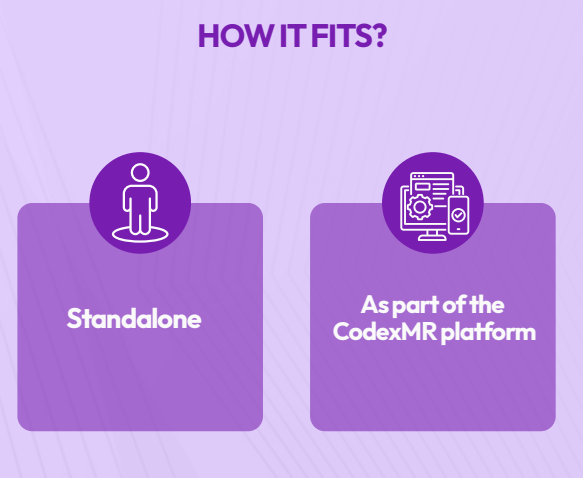
For teams using the CodexMR platform, ResearchReady is part of the automated workflow, built into the pipeline as a standard step between spec and scripting.
For teams coming to ResearchReady as a standalone tool, the process is actually the same: upload the Word document, run the review, act on the findings before anything gets scripted.
Wrap Up
The capacity problem behind multi-level survey quality control is real. A proper review process usually requires several different perspectives. But under real project timelines, coordinating all of those reviews in time to make meaningful changes becomes much harder than it sounds.
The usual outcome is partial review. The researcher approves it, the programmer flags what they see during scripting, and everything else surfaces later.
ResearchReady does not replace those specialists. It structures the review. The research lead still approves the research design. The legal team still clears the compliance flags. The programmer still builds the script. ResearchReady reviews the questionnaire from every angle relevant to each role before it reaches the team’s desk.
That is what seven specialist lenses on a single upload produces. A survey that moves to programming already checked. A handoff that carries the evidence of the review, not just the document.
See ResearchReady on a live questionnaire. Request a walkthrough.
Want to understand where ResearchReady fits in the full CodexMR automated workflow? Read how the six-step pipeline works.