The sample brief goes to three suppliers on a Thursday afternoon. Length of Interview (LOI): 12 minutes. Both the figure and the confidence behind it came from the questionnaire draft — reviewed for content, signed off by a senior researcher, and passed to procurement without much of a structural check.
Two weeks into fieldwork, the actual LOI is running at 16 minutes. The sample budget was built on a figure that did not reflect the questionnaire that went to field. The timeline is wrong. The supplier conversation is already uncomfortable. And the client update scheduled for next week needs to explain a cost variance nobody planned for.
Survey LOI accuracy is not only a fieldwork problem. It is also a questionnaire design problem. The estimate was wrong before a single respondent saw the survey.
Why Survey LOI Accuracy Starts with the Questionnaire, Not the Stopwatch
A LOI estimate built from a questionnaire that has not been structurally validated will be wrong in a predictable direction.
The reasons are structural. For instance:
- Routing errors create longer respondent paths than the design intended.
- Small design decisions have a habit of adding time.
- A routing error sends respondents through questions they should never see.
- A grid takes longer on mobile than expected.
- A confusing question gets read twice, etc.
On paper, those delays look insignificant. In fieldwork, they start showing up in completion times and drop-out rates. Time that does not appear in a desk-based estimate shows up in fieldwork completion data.
Each of these factors adds time individually. Together, they produce a gap between estimated and actual LOI that is wide enough to matter commercially. A 12-minute estimate that runs at 16 minutes in the field is not a minor variance. It is a 33% difference on the variable that determines sample cost, respondent incentive rates, and fieldwork timeline. Every supplier conversation that used the original figure was built on a number that was wrong.
What LOI Inflation Costs and When
- Time is money. The cost of a LOI problem follows the same pattern as other pre-programming errors. The later it surfaces, the more expensive it becomes and the less that can be done about it.
- Caught at the design stage, a LOI problem is a restructuring decision. A routing error is corrected in the document. A grid that was running long on mobile is split or shortened. An unclear question that was producing hesitation gets rewritten. These are document edits. They take time, but they do not affect supplier commitments, sample budgets, or fieldwork timelines — because none of those have been locked yet.
- Caught after the LOI estimate has gone to suppliers, the problem is more contained but still damaging. The sample budget needs to be revised. If incentive rates were set against the original LOI figure, those conversations need to be reopened. The timeline compresses because the revised fieldwork cost has to be approved before the study can launch.
- Caught in fieldwork, a LOI problem produces the scenario that experienced Research Directors recognize immediately. Completion times are running higher than expected. Panel suppliers are flagging that the survey is running long. Drop-out rates (DOR) are climbing at predictable points in the questionnaire. At this stage, the options are to absorb the cost, shorten the survey mid-field (with everything that implies for data integrity), or accept a reduced sample against the original spec.
None of these is a good outcome. All of them were preventable at the design stage. The cost of poor survey LOI accuracy compounds with every stage it survives.
Why the Estimate Gets Locked at the Wrong Point
LOI estimates are built early in the project timeline — typically from a questionnaire draft or spec, before programming begins and often before any pre-programming review has taken place. This is the right time to build them from a planning perspective. It is the wrong time if the questionnaire has not been validated.
The routing has not been checked. The burden has not been assessed against realistic mobile completion behavior. The question wording that will slow some respondents has not been flagged. The LOI estimate built at this stage is built on the assumption that the questionnaire is structurally sound. That assumption is rarely formally tested.
By the time someone notices the structural issues affecting LOI, the estimate has often been circulating. Suppliers have priced the project, timelines have been discussed, and the number has already started shaping decisions. The only remaining question is how much of the variance the project can absorb.
The answer is almost always: less than the variance turns out to be.
Multi-Country Studies Make It Harder to Catch
A single-market study with a LOI problem will surface it in fieldwork and absorb the impact.
A multi-country study with the same problem runs it across every market simultaneously. And LOI does not inflate uniformly across markets. Mobile completion rates vary. Language affects reading pace — a survey that runs at 12 minutes in English may run at 14 or 15 minutes in markets where the translated version is longer or where respondents read more slowly in a second language. Cultural response patterns affect grid completion times. A LOI estimate built on one market’s behavior will be wrong in different ways across different markets.
Pre-programming LOI validation that accounts for market-specific factors — device usage, translation length, section complexity by market — closes this gap before fieldwork starts rather than after it has gone wrong in multiple countries at once.
What to Check Before Your LOI Estimate Goes to a Supplier
Four checks that make survey LOI accuracy meaningfully higher before estimates leave the research team.
- What does the longest routing path run at? The median LOI estimate accounts for the average respondent path. A questionnaire with complex routing may have outlier paths that run three or four minutes longer. If a significant proportion of your sample takes the longer path, the median estimate understates actual LOI. Map the longest path explicitly before the estimate is built.
- What proportion of your sample will complete on mobile? The same questionnaire runs longer on mobile than on desktop. Grid questions in particular take more time on a small screen. If your target audience has high mobile usage, your LOI estimate should reflect mobile completion behavior, not desktop timing. The gap between the two is larger than most desk-based estimates account for
- Does your LOI estimate account for translation length? In multi-country studies, translated questionnaires are routinely longer than the source version. A sentence in English may translate to a longer construction in German or Polish. If the LOI estimate was based on the English version of the questionnaire, some translated markets are likely to run longer.
- Where are your open ends placed, and how many are there? Open-ended questions placed late in a questionnaire after a long grid sequence produce shorter responses but take the same or longer to complete — respondents hesitate, type something brief, and move on. Open ends placed early produce better data and more predictable completion times. Their position in the questionnaire affects both LOI and data quality.
How ResearchReady Approaches Survey LOI Accuracy Before Programming Begins
ResearchReady is our AI-powered survey quality control tool for quantitative research teams. It works both as a standalone tool and as part of the CodexMR platform. The user uploads a Word or Excel questionnaire and review areas relevant to the study and receives a structured review across seven professional lenses.
For LOI, ResearchReady’s Survey Statistics module gives teams a structured basis for estimating survey length before the questionnaire reaches a supplier. It reads the questionnaire and builds a picture of how respondents will actually experience it, taking into account question counts, sections, grids, loops, open-ended questions, routing paths, and the amount of text they need to read on screen.
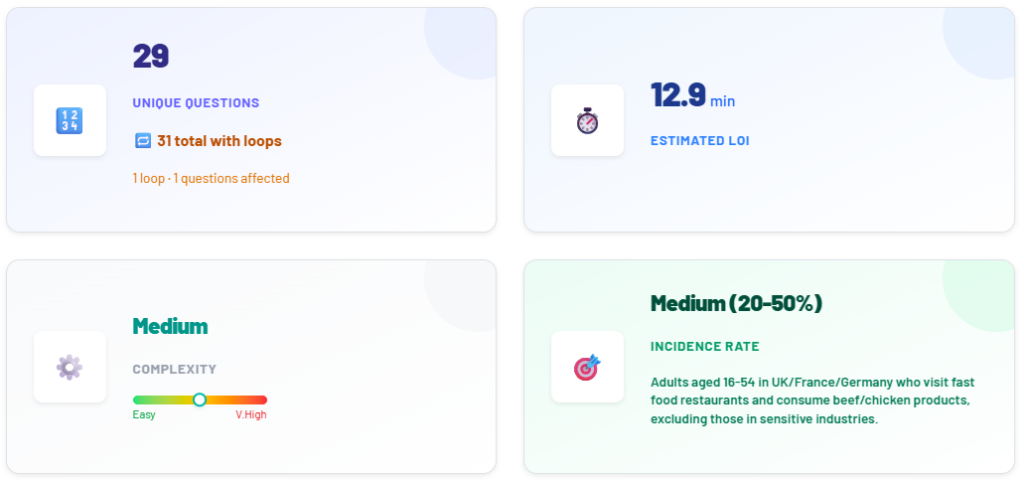
In retrospective testing across 30 completed studies with a mid-size full-service agency, manual LOI estimates missed actual field outcomes by five to six minutes on average.
On one project, the client estimated 15 minutes. ResearchReady estimated 10 minutes. The survey ran at 9 minutes in the field.
On another, the client estimated 15 minutes again. ResearchReady estimated 21 minutes. Actual field LOI: 20 minutes.
The same manual approach produced a significant overestimate in one direction and a significant underestimate in the other. ResearchReady came within one minute of the actual outcome both times.
Wrap Up
A mid-fieldwork conversation about a survey LOI accuracy problem that nobody caught at the design stage is uncomfortable regardless of how you manage it. Teams have a very different conversation when they validate the estimate before it reaches suppliers. The project is still running long. But it is running long for reasons the team can point to, not reasons they missed.
See how Research Ready validates your questionnaire before LOI estimates go to suppliers. Request a demo.
Understand all five validation areas Research Ready covers. Read the Survey Validation Checklist